
What does the rule of three in nursing mean?
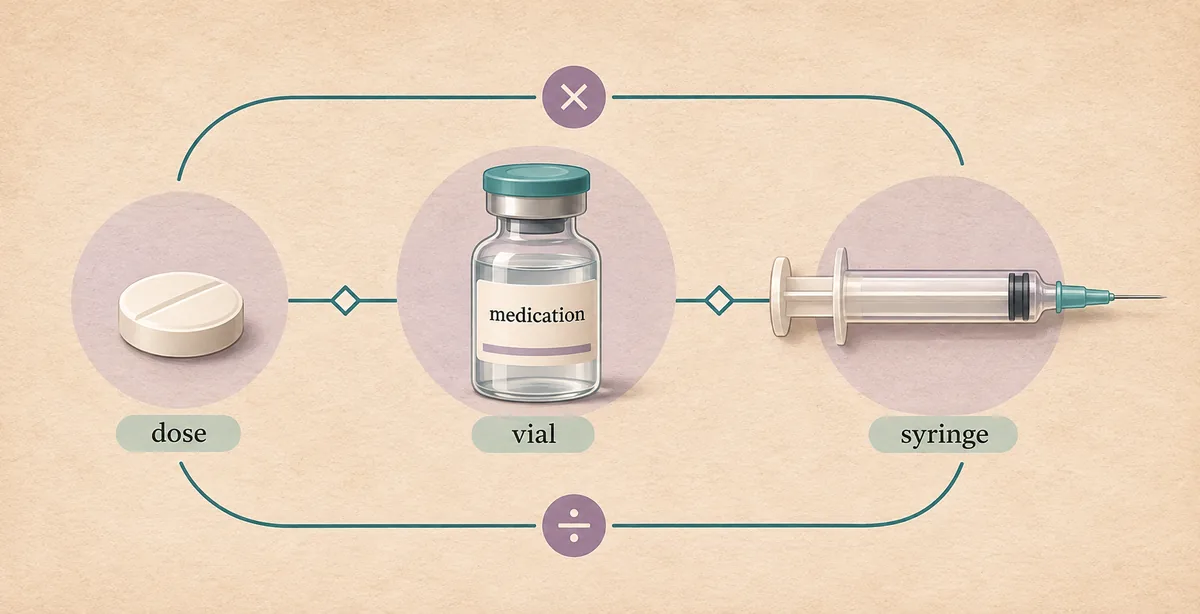
The rule of three in nursing is an orderly way to solve a proportion when you know the required dose, the amount of medicine in a presentation, and the matching volume or number of units. Instead of memorizing a number, you place equivalent quantities on the same line, keep their units visible, and solve for the unknown.
A typical problem may say that a vial contains 500 mg in 2 ml and that the order calls for 250 mg. The mathematical goal is to find how many milliliters represent those 250 mg. The rule of three for medication does not decide whether the order is appropriate; it only translates a numerical relationship that the responsible team must already have reviewed.
The procedure works for solutions, tablets, ampoules, or mass conversions as long as the prescribed unit can be compared with the presentation unit. If the label uses grams and the order uses milligrams, convert before multiplying. Mixing units can produce an answer that looks correct while having the wrong magnitude.
Why show the complete rule of three in nursing relationship?
Writing the proportion lets another person see what every number means. It also shows whether the result should be a volume, a fraction of a tablet, a rate per hour, or a total amount. A calculator can perform multiplication, but it cannot know that you confused mg with ml or selected a different presentation.
In learning situations, an inverse check matters as much as the answer. If 500 mg correspond to 2 ml, then 250 mg should correspond to half the volume, 1 ml. If your operation gives 10 ml, the comparison of magnitudes warns that something does not fit and that you should stop before continuing.
Rule of three in nursing dose formula
Call the dose available on the label D and the accompanying volume V. Call the prescribed dose P and the volume sought X. The relationship is D : V = P : X. Solving it gives X = (V × P) ÷ D. This is the same as a direct rule of three because, within a fixed presentation, a larger dose represents a larger volume.
The important part is not memorizing letters but writing every value with its unit. If D is in mg, P must also be in mg; if V is in ml, X will be in ml. When a presentation is expressed in tablets, X represents tablets or fractions and you must check whether the product may be split under the professional instruction.
D mg : V ml = P mg : X ml → X = (V × P) ÷ D
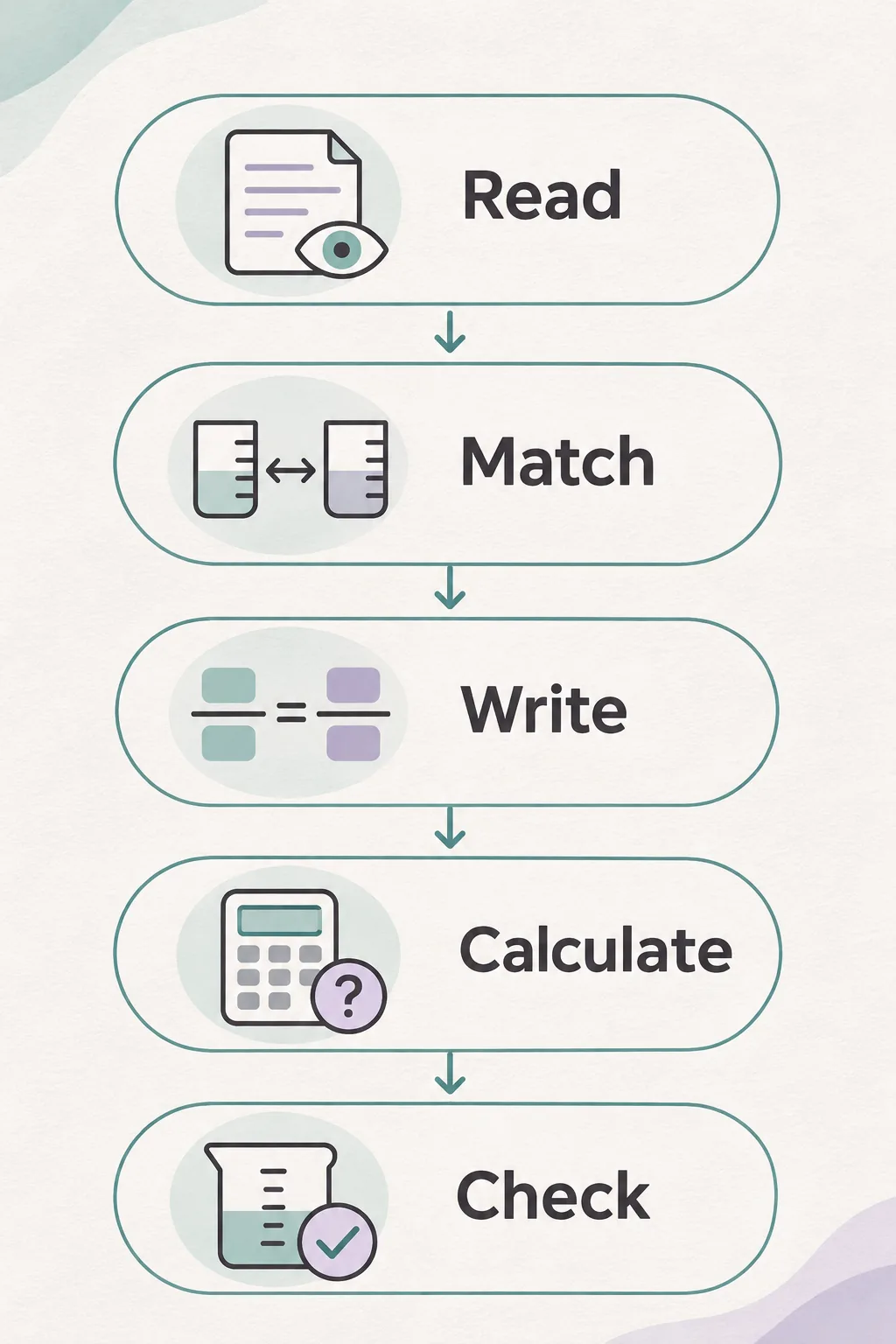
Rule of three in nursing: five calculation steps
Read the problem twice: once to understand what is requested and again to extract numbers and units. Do not round while setting up the operation. These steps create a record that can be reviewed; they do not turn an order into a clinical recommendation.
1. Identify the unknown
Write what you must find and the unit it should use. It may be a volume in ml, an amount in mg, a tablet, or a rate per hour.
2. Separate order and presentation
Record the prescribed dose in one column and the available dose with its volume or number of units in another. Do not mix data from two different containers.
3. Convert before operating
Convert grams to milligrams, micrograms to milligrams, or hours to minutes only when appropriate. Keep the written conversion so another person can audit it.
4. Substitute and calculate
Use X = (available volume × prescribed dose) ÷ available dose. Keep parentheses and the unit beside the number during review.
5. Check and document
Review the direction of the proportion, result size, permitted rounding, and protocol. If a figure does not match the label or order, stop and ask.
Rule of three in nursing medication examples
The following cases are arithmetic exercises, not instructions for administering drugs. Simple numbers show the structure: available dose, available volume, prescribed dose, and a result with units.
A real situation also involves route, rate, stability, final concentration, patient factors, and facility policy. A proportion cannot infer those details; authorized staff must verify them.
1. Milligram dose and ml volume
Exercise: a presentation contains 500 mg in 2 ml, and the academic question asks for the volume equivalent to 250 mg.
Both doses are in mg and the reference volume is in ml. Since 250 mg is half of 500 mg, the expected volume should be half of 2 ml.
X = (2 ml × 250 mg) ÷ 500 mg = 1 mlMathematical result: The proportion produces 1 ml in this exercise.
Check: 500 mg ÷ 2 ml = 250 mg per ml; 1 ml represents 250 mg. In practice, the label, order, and protocol must agree before any figure is used.
2. Concentration with a different volume
Exercise: a bottle contains 750 mg in 5 ml, and the proportional volume for 300 mg is requested.
The presentation establishes a fixed relationship of 750 mg per 5 ml. The target dose is smaller, so the volume should be less than 5 ml.
X = (5 ml × 300 mg) ÷ 750 mg = 2 mlMathematical result: The arithmetic answer is 2 ml.
Check: 750 mg ÷ 5 ml = 150 mg per ml; 2 ml × 150 mg per ml = 300 mg. The result does not decide route or frequency.
3. Tablet presentation
Exercise: one tablet contains 1 g, and the problem asks for 500 mg expressed as part of that unit.
First convert 1 g to 1,000 mg. Then compare the target dose with one complete tablet; do not put grams and milligrams on the same line.
X = (1 tablet × 500 mg) ÷ 1,000 mg = 0.5 tabletMathematical result: The proportion gives half a tablet as a mathematical result.
Check: 0.5 × 1,000 mg = 500 mg. Whether a tablet can be split depends on the product and professional authorization; never assume it from the calculation.
4. Academic rate conversion
Exercise: 1,000 ml of solution is distributed evenly over 8 hours, and the rate per hour is requested.
Here a total volume is divided by a total time; this is not a medication dose by itself. Keep the constant-flow assumption and use the time unit requested by the exercise.
X = 1,000 ml ÷ 8 h = 125 ml/hMathematical result: The mathematical rate is 125 ml per hour.
Check: 125 ml/h × 8 h = 1,000 ml. A real rate requires review of limits, pump, route, and protocol; this example teaches units only.
Rule of three in nursing: review mg, g, ml, tablets, and hours
Most mistakes in a medication rule of three occur while reading the unit, not while multiplying. A milligram measures mass and a milliliter measures volume; they are not interchangeable. Concentration connects them in a particular presentation, such as a stated number of mg per number of ml.
Before rounding, keep every decimal produced by the operation. Then apply the facility rule, device precision, and available form of the medicine. Rounding up simply to make a number look neat can change the actual amount. If the result does not fit a syringe, cup, or tablet that is available, review the answer rather than adjusting it by eye.
- Convert 1 g = 1,000 mg and 1 mg = 1,000 micrograms only when the label and order require it.
- Keep ml and l separate; 1 l = 1,000 ml. Write the conversion beside the original value.
- Do not confuse mg/ml with ml/mg: reversing the concentration changes the result.
- State whether X is a total amount, an amount per dose, or a rate per hour.
- Use decimal commas or points consistently and confirm the format required by local policy.
What the rule of three in nursing cannot solve
The rule of three in nursing solves a proportional relationship, but it does not validate an order. It cannot determine an appropriate patient dose, correct dilution, compatibility, infusion rate, or frequency. Those decisions depend on a prescription, current label, patient situation, and service protocols.
If the prescribed dose seems incompatible with the presentation, a unit is missing, two similar concentrations are present, or the calculation produces an unexpected volume, stop. Recording a question and requesting a second check is safer than correcting a number from memory.
The examples on this page omit patient names and are not real orders. For study, compare your method with teaching material and medication-calculation references; at work, follow the verification chain established by your institution.
Current order Confirm patient, medicine, dose, route, schedule, and any limit stated by the protocol.
Correct presentation Check concentration, total volume, expiry, and whether the container matches the calculation.
Equivalent units Make sure prescribed and available doses use the same unit before solving for X.
Reasonable result Compare size, direction, and unit; an unusual number is a signal to revisit the set-up.
Authorized rounding Apply only the precision allowed by the device, presentation, and local policy.
Second review When policy requires it or the case is high risk, request an independent check.
Rule of three in nursing: direct, inverse, or compound?
For a dose taken from a fixed presentation, the relationship between dose and volume is usually direct: if the target dose increases, the proportional volume increases. That does not mean every nursing problem is direct. The relationship changes when you ask about times, rates, or several quantities at once.
Before choosing a formula, write what remains constant. An inverse proportion preserves a product, such as speed multiplied by time for a fixed distance. A compound rule combines more than two changes, for example concentration, volume, and time. If you cannot explain the fixed condition, reread the order and ask for guidance.
| Situation | Direct | Inverse | Compound |
|---|---|---|---|
| Dose and volume from one presentation | More dose at the same concentration requires more volume. | This is not the usual model. | Only when another quantity also changes. |
| Rate and time for a fixed amount | Time does not increase when rate rises. | More rate can mean less time. | Analyze it if the amount also changes. |
| Several containers or conversions | One simple ratio may be enough when units match. | Do not assume it by intuition. | Justify each ratio separately. |
| Unexpected result | Review dose, presentation, and units. | Review which product should stay constant. | Review every quantity and relationship. |
Rule of three in nursing: educational sources and scope
Proportion mathematics is general, but medication calculation needs clinical context. These sources help compare methods; decisions about use must follow the relevant training and protocol.
- StatPearls: Dose Calculation Ratio and Proportion MethodReviews dose-calculation methods and the importance of units.
- Open Text BC: Calculating Medication DosageProvides numeracy exercises for nursing students.
Rule of three in nursing questions
What is the rule of three in nursing?
It is a way to relate a prescribed dose to the amount of medicine and volume in a known presentation. It helps solve for a value, but it does not validate the order or replace protocol.
What is the medication calculation formula?
If D is available dose, V available volume, and P prescribed dose, X = (V × P) ÷ D. D and P must use the same unit, and X keeps V's unit.
How do I know whether to use mg or ml?
A dose may be in mg, g, or micrograms, while volume is in ml or l. Convert mass units so they match and leave volume as the unknown's unit.
Can I split any tablet if the result is 0.5?
No. The calculation expresses only a mathematical fraction. Whether a tablet can be split depends on its design, product information, order, and protocol; confirm before use.
What should I do if the result seems too large or small?
Stop, review the label, units, concentration, decimals, and presentation. Then request an independent check according to local policy.
Does the rule of three replace clinical calculation?
No. It solves a proportion. It does not decide indication, route, frequency, dilution, compatibility, or rate, and never replaces a prescription or professional review.