
Rule of Three for Calculating Percentages: Step-by-Step Examples
Learn how to line up the part, the total and 100 percent, choose the right unknown, and check discounts, increases and school exercises.
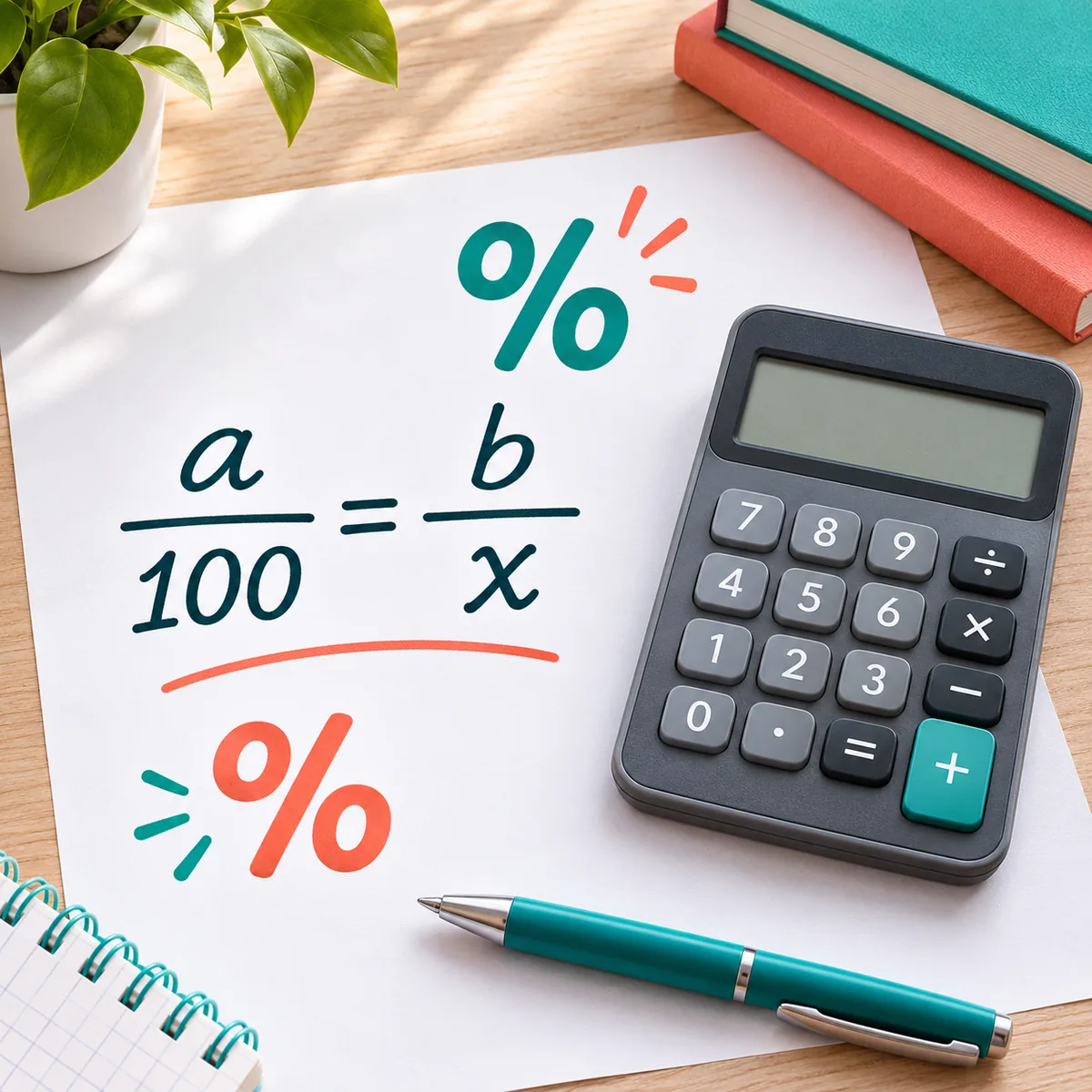
How do you use the rule of three for calculating percentages?
A percentage expresses part of an amount against a base of one hundred. Saying 20% means 20 out of every 100, so a part and a total can be connected with a proportion. The rule of three finds the fourth value when three positions in that relationship are known.
In the most common case, the total equals 100% and the part equals X%. The mental table is total → 100% and part → X%. Both quantities move in the same direction, so this is a simple direct rule of three. The order matters: the total is the base that occupies the 100% position.
Before calculating, decide what question you are answering. You may need the percentage represented by a part, the amount represented by a percentage, or the total when a part and its percentage are known. The same idea solves all three questions, but X moves to a different position and the rearranged formula changes.
The 100% base is the key clue
If the question mentions a full class, an original price, every answer, or the value before a discount, that amount is usually the base. Do not confuse the observed part with the total. Swapping them can produce a plausible number that answers a different question.
The rule of three formula for percentages
To find what percentage a part represents, write part ÷ total = X ÷ 100. Cross multiplication gives total × X = part × 100. Isolate X by dividing by the total and report the final percentage.
The compact form is X = (part × 100) ÷ total. The answer is a percentage because the reference in the proportion is 100. Keep the parentheses until the multiplication is complete, and round only when the question states how many decimal places are needed.
When you want a part and already know the percentage, the unknown changes place: 100% corresponds to the total and the known percentage corresponds to X. Then part = (percentage × total) ÷ 100. When the total is unknown, use total = (part × 100) ÷ percentage.
total → 100% | part → X% | X = (part × 100) ÷ total
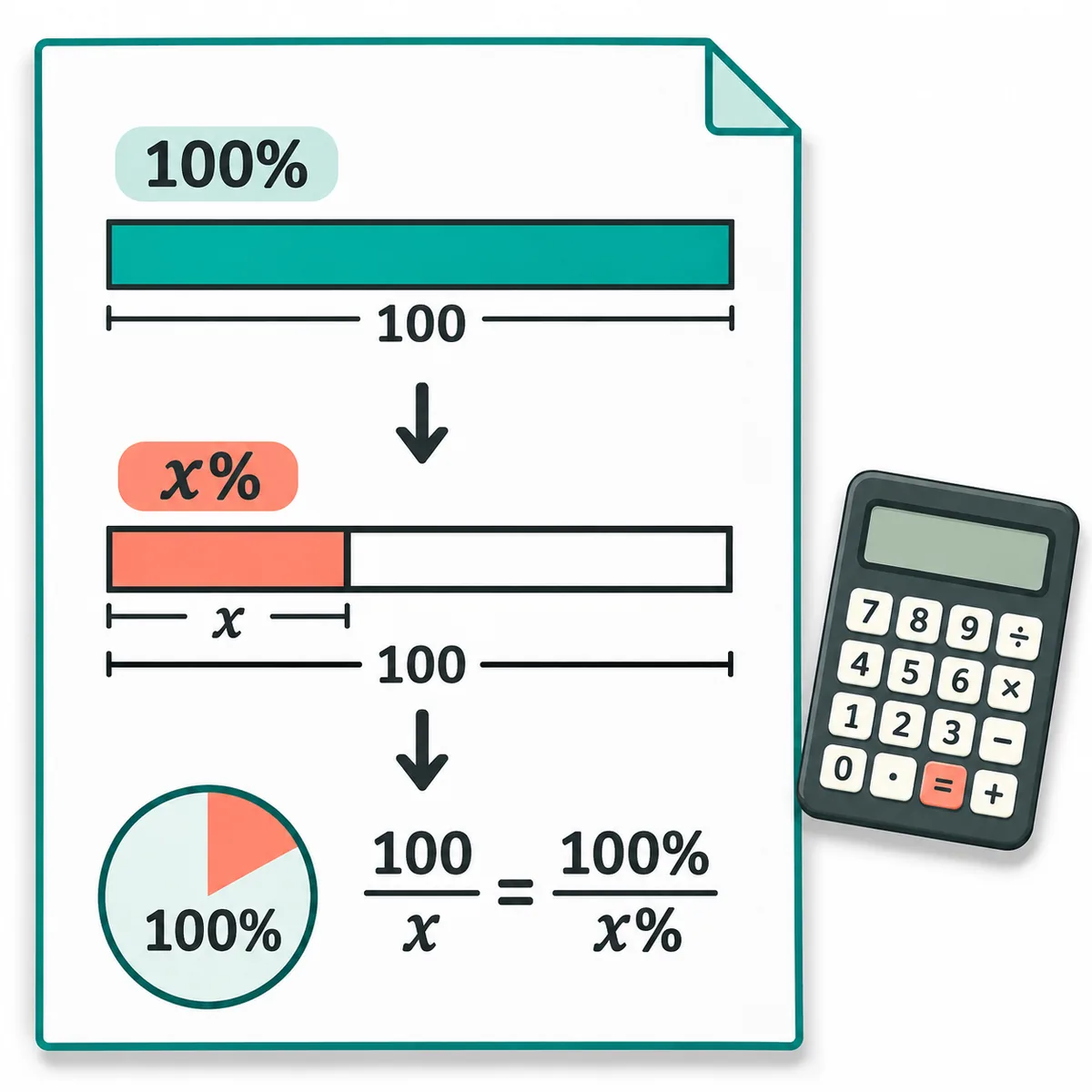
How to calculate a percentage in five steps
A labelled setup prevents mistakes with the base, units and direction. Use these steps for homework or to check a discount on a receipt. Write what each value means before substituting numbers, and keep the wording that explains the base.
1. Name the total
Find the complete amount against which the part is measured. It is the reference and belongs in the 100% position.
2. Locate the part
Find the observed, paid, correct or separated amount. Write its unit and do not mix it with another measurement.
3. Choose the unknown
Ask whether you need a percentage, a part or a total. Put X exactly in that position of the table.
4. Multiply and divide
For a percentage use (part × 100) ÷ total. For a part use (percentage × total) ÷ 100; for a total use (part × 100) ÷ percentage.
5. Check the meaning
A part smaller than the total normally gives less than 100%. Substitute the result back into the relationship and round only at the end.
Four percentage exercises using the rule of three
These examples cover the three common positions of X plus an everyday discount. In every case, the base is identified before doing the operation; that decision is as important as the multiplication.
If the answer contains decimals, keep several digits during the calculation. Money can be rounded to two decimal places, while a school exercise may need one more digit with the rounding explained.
What percentage is a part?
A class has 250 students and 50 handed in the assignment on time. What percentage does that part represent?
250 → 100% | 50 → X% | X = (50 × 100) ÷ 250 = 20%Result: 50 students represent 20% of the class.
Check that 20% of 250 is 50. Because the part is smaller than the total, a 20% result makes sense.
Calculate a part from a percentage
Find 30% of 360. The total is 360 and the known percentage is 30%.
100% → 360 | 30% → X | X = (30 × 360) ÷ 100 = 108Result: 30% of 360 is 108.
Divide 108 by 360 and multiply by 100: the result is 30%. This is also 360 multiplied by 0.30.
Find the total from a part and percentage
Twenty-five percent of an amount is 49. What is the complete amount?
25% → 49 | 100% → X | X = (49 × 100) ÷ 25 = 196Result: The total amount is 196.
Twenty-five percent of 196 is 49. If 25 were treated as the total, the original relationship would not be preserved.
Check a discount
A backpack cost 80 euros and has a 25% discount. How much is the discount and what is the final price?
100% → €80 | 25% → X | X = (25 × 80) ÷ 100 = €20Result: The discount is €20 and the final price is €60.
Subtract the discount from the original base: 80 − 20 = 60. Do not add 25% to the reduced price to reverse it; the base is the original price.
Three positions for the unknown X
The word percentage can hide different questions. Turn the wording into one of these three structures before choosing a formula. The base is always the amount that represents 100%, but X may be the percentage, the part or the total.
| Question | Relationship | Rearranged formula |
|---|---|---|
| What percentage is a part of a total? | total → 100%; part → X% | X = (part × 100) ÷ total |
| What is P% of a total? | 100% → total; P% → X | X = (P × total) ÷ 100 |
| What is the total when P% is a part? | P% → part; 100% → X | X = (part × 100) ÷ P |
| What discount separates two prices? | initial price → 100%; difference → X% | X = (difference × 100) ÷ initial price |
What to check before accepting the result
The rule of three calculates a specific proportional relationship; it cannot interpret the context for you. In price, grade, tax or measurement problems, confirm the base and the unit used by each number.
- Do not swap part and total. The denominator represents what you have chosen as 100%.
- Do not add successive discounts as if they had the same base: the second discount applies to the already changed price.
- Convert units first. 500 millilitres and 0.5 litres are equal, but you should not divide them without making the conversion explicit.
- A percentage above 100% can be correct when the part exceeds the base; review the wording before rejecting it.
- Never divide by zero. If the total or known percentage is zero, the formula may be undefined and more information is needed.
- For medical, financial or tax decisions, use the arithmetic as support and confirm the interpretation, units and rules with a qualified person.
Questions about calculating percentages with a rule of three
What is the formula for calculating a percentage with the rule of three?
If you know the part and the total, write total → 100% and part → X%. The formula is X = (part × 100) ÷ total, and X is reported as a percentage.
How do I know which value is the total?
The total is the complete reference amount: the original price, every answer, the full mixture or all people. That amount represents 100%.
How do I calculate 15% of an amount?
Put 100% beside the total and 15% beside X. Calculate X = (15 × total) ÷ 100. For example, 15% of 800 is 120.
What percentage is 40 of 200?
Set up 200 → 100% and 40 → X%. X = (40 × 100) ÷ 200 = 20%, so 40 is 20% of 200.
How do I calculate a discount with the rule of three?
Treat the original price as 100%, calculate the discount amount, and subtract it from the original. A 25% discount on €80 is €20, leaving €60.
Is the rule of three for percentages always direct?
When you compare a part with a fixed total and 100%, yes: both quantities move in the same direction. If several conditions change, check whether a compound or inverse relationship is needed.
Can I check the answer without a calculator?
Yes. Turn the percentage into a fraction or decimal and multiply by the total. When looking for a percentage, divide part by total and multiply by 100; both checks should agree.